Pemanfaatan Literasi Ekonomi Syariah dan Teknologi Blockchain dalam Membentuk Ketahanan Finansial Berbasis Komunitas: Studi Kasus Kahfi BBC Motivator School
DOI:
https://doi.org/10.55606/jpkmi.v2i1.10950Keywords:
Sharia Economics; Cryptocurrency; Blockchain; Financial Literacy; ABCD Method; Kahfi BBC SchoolAbstract
The rapid disruption of the Fourth Industrial Revolution has introduced complex financial technologies, specifically cryptocurrency and blockchain, into the fabric of Indonesian society. This phenomenon presents a dichotomy: the promise of decentralized transparency versus the peril of speculative volatility, which often conflicts with Islamic legal principles (Maqasid Shariah). This community engagement research aims to bridge the literacy gap regarding Sharia economics, cryptocurrency legality, and the advancement of Islamic technology within the academic community of Kahfi BBC Motivator School. Utilizing a qualitative approach with a Participatory Action Research (PAR) design framed by the Asset-Based Community Development (ABCD) methodology, this study integrates the intellectual assets of IIQ Jakarta with the unique "Ilmu Fikir" curriculum of Kahfi School. The research involved 100 participants through a series of in-depth seminars, focus group discussions (FGD), and asset mapping workshops. The findings reveal that: (1) The "non-transactional" education model of Kahfi School serves as a potent spiritual asset for mitigating the greed factor in crypto trading; (2) Blockchain technology holds transformative potential for Zakat and Waqf transparency, aligning with the principle of Tabayyun; (3) There is a critical need to differentiate between cryptocurrency as a currency (haram) and as a digital asset (mubah with strict conditions) based on prevailing regulations (Bappebti 2019/2020) and scholarly discourse; (4) The ABCD intervention successfully transformed students into "Digital Sharia Agents".
References
Badan Pengawas Perdagangan Berjangka Komoditi. (2019). Peraturan Bappebti Nomor 5 Tahun 2019 tentang ketentuan teknis penyelenggaraan pasar fisik aset kripto. Jakarta: Kementerian Perdagangan RI.
Badan Pengawas Perdagangan Berjangka Komoditi. (2020). Peraturan Bappebti Nomor 7 Tahun 2020 tentang penetapan daftar aset kripto yang dapat diperdagangkan. Jakarta: Kementerian Perdagangan RI.
Bank Indonesia. (2016). Peraturan Bank Indonesia No. 18/40/PBI/2016 tentang penyelenggaraan pemrosesan transaksi pembayaran. Jakarta: Bank Indonesia.
Creswell, J. W., & Creswell, J. D. (2018). Research design: Qualitative, quantitative, and mixed methods approaches (5th ed.). Los Angeles: SAGE Publications.
Elasrag, H. (2019). Blockchains for Islamic finance: Obstacles & challenges. Munich Personal RePEc Archive.
Elkington, J. (2018, June 25). 25 years ago I coined the phrase 'triple bottom line.' Here's why it's time to rethink it. Harvard Business Review.
Esrati, S. N., Nor, S. M., & Majid, M. A. (2018). FinTech (blockchain) dan pengurusan zakat di Malaysia. Prosiding Persidangan Kebangsaan Ekonomi Malaysia Ke-13.
Hamin, D. I. (2020). Crypto currensi dan pandangan legalitas menurut Islam. Jurnal Ilmiah Manajemen dan Bisnis, 3(2), 127–139.
Kementerian Koperasi dan UKM RI. (2020). Laporan perkembangan UMKM dan besar tahun 2018-2019. Jakarta: Kementerian Koperasi dan UKM.
Majelis Ulama Indonesia. (2017). Fatwa DSN-MUI No. 116/DSN-MUI/IX/2017 tentang uang elektronik syariah. Jakarta: DSN-MUI.
Pemerintah Republik Indonesia. (2011). Undang-Undang Nomor 7 Tahun 2011 tentang Mata Uang.
PWNU Jawa Timur. (2018). Keputusan bahtsul masail PWNU Jawa Timur tentang hukum bitcoin. Surabaya: PWNU Jatim.
Rahadi, R. A. (2020). Pengembangan kapasitas UMKM melalui digitalisasi: Tantangan dan solusi. Jurnal Manajemen dan Kewirausahaan, 22(3), 156–166.
Setyawan, W. H., et al. (2018). Asset based community development (ABCD). Kediri: PT. Gaptek Media Pustaka.
Siswantoro, D., Handika, R., & Mita, A. F. (2020). The requirements of cryptocurrency for money, an Islamic view. Heliyon, 6.
Downloads
Published
How to Cite
Issue
Section
License
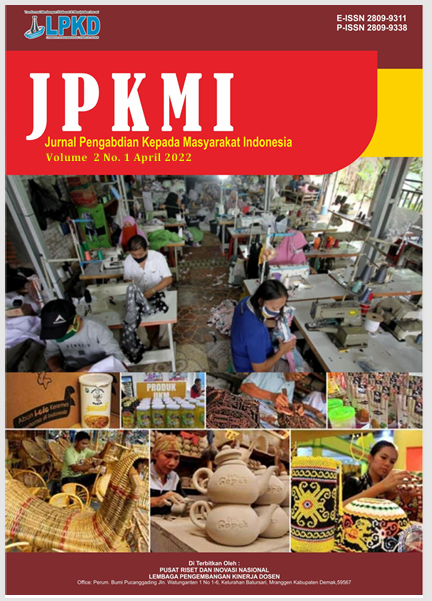
Copyright (c) 2022 Jurnal Pengabdian kepada Masyarakat Indonesia (JPKMI)

This work is licensed under a Creative Commons Attribution-ShareAlike 4.0 International License.